publications
publications by categories in reversed chronological order. generated by jekyll-scholar.
Under review
- Emerging behaviour of game-theoretic LLM agents in an AI regulation gameAlessio Buscemi, Daniele Proverbio, Paolo Bova, Nataliya Balabanova, Adeela Bashir, Theodor Cimpeanu, Henrique Correia Fonseca, Manh Hong Duong, Elias Fernandez Domingos, António M. Fernandes, Marcus Krellner, Ndidi Bianca Ogbo, Simon T. Powers, Fernando P. Santos, Zia Ush Shamszaman, Zhao Song, Alessandro Di Stefano, and The Anh Han2026Under review at AIES-26
- When Cooperation Predictions Become Reasons to Defect: Policy Defaults in LLM Assistance for Social DilemmasKazunori Terada, Henrique Fonseca, Celso M. Melo, Giorgio Coricelli, and Jonathan Gratch2026Under review at AIES-26
AI systems increasingly provide advice about how humans should act toward one another. We audit LLMs asked for advice in one-shot and five-round Prisoner’s Dilemma tasks using fictional counterpart profiles. In Study 1, 14 model conditions from OpenAI, Anthropic, and Google evaluated 60 profiles and returned both a predicted cooperation probability and a Cooperate/Defect recommendation. Models showed broadly similar prediction patterns, assigning high cooperation probabilities to Cooperative profiles and low probabilities to Blameworthy profiles, but their recommendations diverged sharply. Some treated predicted cooperativeness as a reason for reciprocal cooperation, whereas others treated it as compatible with payoff-maximizing defection under the minimal one-shot prompt. A consequence-scope check further showed that several near-defection defaults shifted toward cooperation when consequences beyond the immediate payoff were made explicit. In Study 2, a five-round audit showed that models could open or repair cooperation while still converting cooperative or repaired histories into final-round defection. These findings show that evaluating LLM assistance in social dilemmas requires separating social prediction from recommendation policy. Advice that accurately identifies cooperators but treats their good standing as a signal of exploitability could discourage cooperators from extending goodwill and undermine the reputation-based mechanisms that sustain large-scale cooperation.
2026
-
 Media and responsible AI governance: a game-theoretic and LLM analysisNataliya Balabanova, Adeela Bashir, Paolo Bova, Alessio Buscemi, Theodor Cimpeanu, Henrique Correia Fonseca, Alessandro Di Stefano, Manh Hong Duong, Elias Fernandez Domingos, António Fernandes, The Anh Han, Marcus Krellner, Ndidi Bianca Ogbo, Simon T. Powers, Daniele Proverbio, Fernando P. Santos, Zia Ush Shamszaman, and Zhao SongPhilosophical Transactions of the Royal Society A, Oct 2026
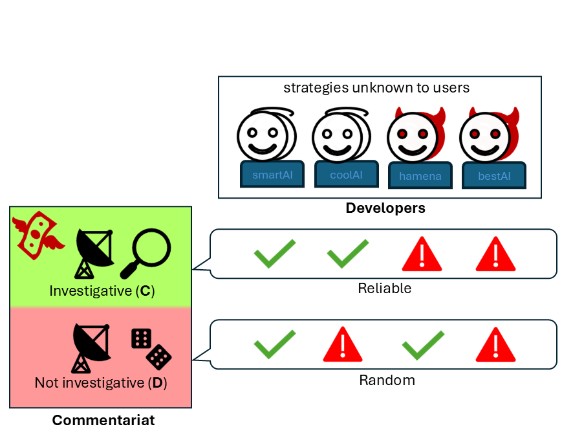
This paper investigates the complex interplay between AI developers, regulators, users, and the media in fostering trustworthy AI systems. Using evolutionary game theory and large language models (LLMs), we model the strategic interactions among these actors under different regulatory regimes. The research explores two key mechanisms for achieving responsible governance, safe AI development and adoption of safe AI: incentivising effective regulation through media reporting, and conditioning user trust on commentariats’ recommendation. The findings highlight the crucial role of the media in providing information to users, potentially acting as a form of "soft" regulation by investigating developers or regulators, as a substitute to institutional AI regulation (which is still absent in many regions). Both game-theoretic analysis and LLM-based simulations reveal conditions under which effective regulation and trustworthy AI development emerge, emphasising the importance of considering the influence of different regulatory regimes from an evolutionary game-theoretic perspective. The study concludes that effective governance requires managing incentives and costs for high quality commentaries.
2025
-
 Evolution of indirect reciprocity under emotion expressionHenrique Correia Fonseca, Celso M. Melo, Kazunori Terada, Jonathan Gratch, Ana S. Paiva, and Francisco C. SantosScientific Reports 2025 15:1, Mar 2025
Do emotion expressions impact the evolution of cooperation? Indirect Reciprocity offers a solution to the cooperation dilemma with prior work focusing on the role of social norms in propagating others’ reputations and contributing to evolutionarily stable cooperation. Recent experimental studies, however, show that emotion expressions shape pro-social behaviour, communicate one’s intentions to others, and serve an error-correcting function; yet, the role of emotion signals in the evolution of cooperation remains unexplored. We present the first model of IR based on evolutionary game theory that exposes how emotion expressions positively influence the evolution of cooperation, particularly in scenarios of frequent errors. Our findings provide evolutionary support for the existence of emotion-based social norms, which help foster cooperation among unrelated individuals.
-
 Can Media Act as a Soft Regulator of Safe AI Development? A Game Theoretical AnalysisHenrique Correia Fonseca, António Fernandes, Zhao Song, Theodor Cimpeanu, Nataliya Balabanova, Adeela Bashir, Paolo Bova, Alessio Buscemi, Alessandro Di Stefano, Manh Hong Duong, Elias Fernandez Domingos, Ndidi Bianca Ogbo, Simon T. Powers, Daniele Proverbio, Zia Ush Shamszaman, Fernando P. Santos, The Anh Han, and Marcus KrellnerIn The 2025 Conference on Artificial Life, Oct 2025
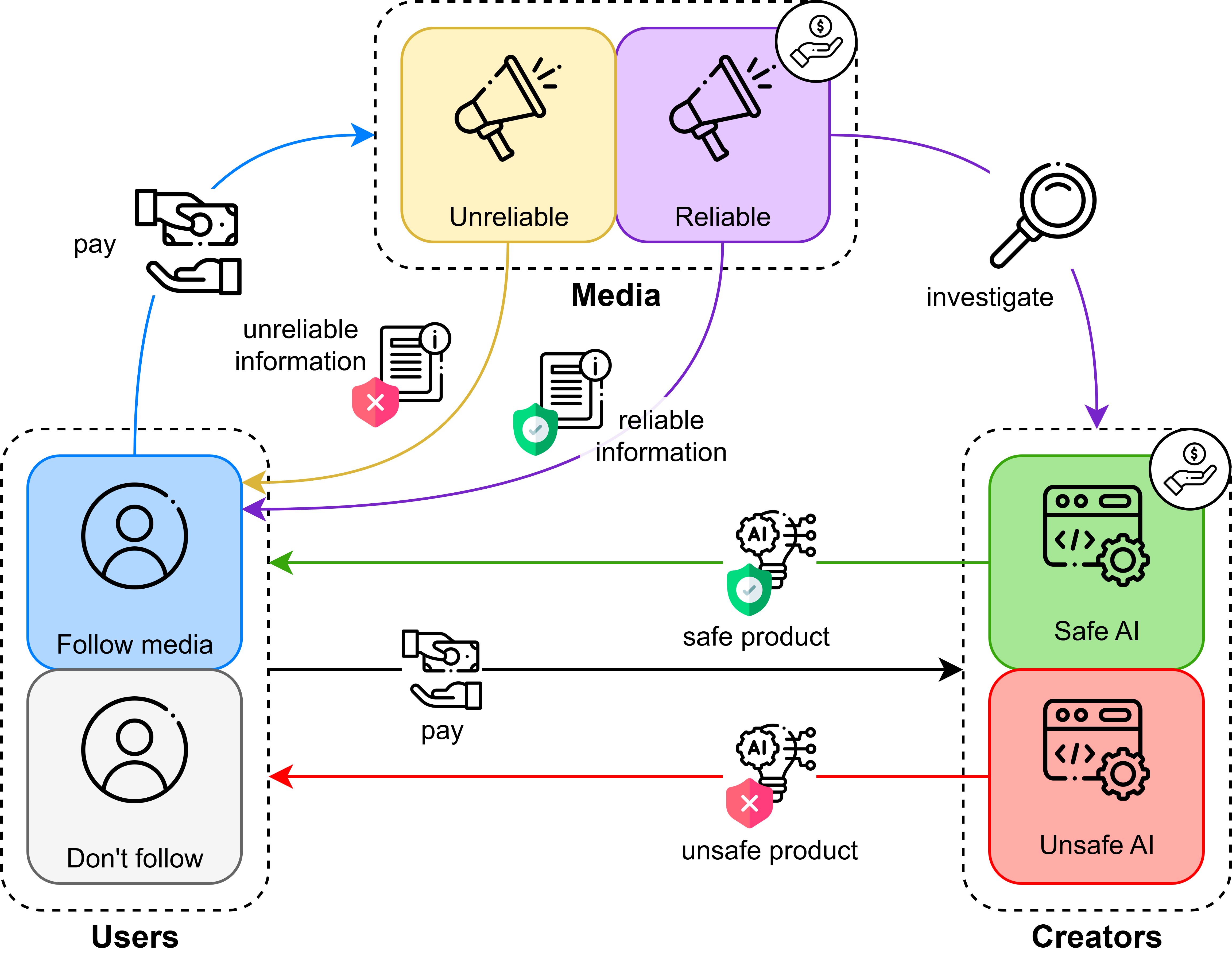
When developers of artificial intelligence (AI) products need to decide between profit and safety for the users, they likely choose profit. Untrustworthy AI technology must come packaged with tangible negative consequences. Here, we envisage those consequences as the loss of reputation caused by media coverage of their misdeeds, disseminated to the public. We explore whether media coverage has the potential to push AI creators into the production of safe products, enabling widespread adoption of AI technology. We created artificial populations of self-interested creators and users and studied them through the lens of evolutionary game theory. Our results reveal that media is indeed able to foster cooperation between creators and users, but not always. Cooperation does not evolve if the quality of the information provided by the media is not reliable enough, or if the costs of either accessing media or ensuring safety are too high. By shaping public perception and holding developers accountable, media emerges as a powerful soft regulator – guiding AI safety even in the absence of formal government oversight.
-
 Assistant Robots with an Agenda foster Uncooperative BehaviorsJoana Brito, Regina Brito Duarte, Henrique Correia Fonseca, Joana Campos, Filipa Correia, and Ana PaivaIn 2025 34th IEEE International Conference on Robot and Human Interactive Communication (RO-MAN), Oct 2025
Although research often explores how human-robot interaction influences cooperation in social dilemma scenarios such as the Public Goods Game, most research focuses on robots taking active roles in the game i.e. opponents or team-players. Considering the potential of assistant robots to influence human decision-making, this study explores how an assistant robot with prosocial or individualistic goals influences cooperation in a Public Goods Game. In a between-subjects study (N=60), participants interacted with the robot in one of three conditions: Prosocial, where the robot supported cooperative behavior; Individualistic, where it encouraged self-serving actions; and Control, where the robot provided feedback on the game state without expressing individual goals. Results revealed that participants in the Prosocial or Individualistic conditions contributed less to the public good compared to those in the Control condition. The Prosocial and Individualistic robots were perceived as warmer but evoking more discomfort compared to the Control. Notably, participants who played with the Prosocial robot reported increased trust, not only in the robot but also in their fellow players. These findings suggest that alignment between an assistant robot’s goals and expected social norms plays a key role in trust perception and it also shapes group dynamics. We discuss important considerations for designing assistant robots that provide moral recommendations.